Am I in Early Perimenopause? Everything You Need to Know
How to identify the first stage of the transition, and what to do when your GP tells you your bloods are normal.
You've been to your GP. You told them about the sleep disruption, the anxiety that came from nowhere, the fatigue that doesn't shift, the periods that have changed. You asked about your hormones.
They ran a blood test, or told you it wasn't necessary, and came back with "your results are normal." Or: "You're too young for perimenopause." Or: "That's just stress."
And yet nothing has improved. And something still feels off.
If this is your experience, you are not imagining it. You are also not alone. This is one of the most common stories I hear in my practice, and it represents a significant gap in how early perimenopause is recognised and investigated in conventional medicine.
Why Early Perimenopause Gets Missed
Early perimenopause begins with progesterone decline, often years before oestrogen becomes significantly dysregulated. A standard hormone panel, oestrogen and FSH, drawn at a random point in the cycle, is poorly designed to detect this. FSH can remain completely normal throughout early perimenopause. Oestrogen may appear within range between fluctuations.
A single snapshot cannot detect a pattern. And perimenopause, especially in its early stages, is defined by pattern.
Add to this the fact that the symptoms of early perimenopause overlap with anxiety, depression, burnout, thyroid dysfunction, and iron deficiency, and it becomes clear why the clinical picture so often gets missed, or gets treated in pieces without anyone looking at what is actually happening underneath.
As a naturopath who’s been in clinical practice for over 18 years I can say that perimenopause is finally getting the attention it deserves, however one of the things that frustrates me most is that everything is now being dumped in the perimenopause bin!
The reality I’m seeing in clinic is a woman who has likely had a couple of kids, generally a little later, who has also been in a demanding work role, and hasn’t had the time or space to prioritise her health. This leads to nutrient deficiencies, most commonly iron, B12, iodine, and magnesium, just to name a few; it has become routine for me now to pick up at least one nutrient deficiency in a patient on their first or second round of testing.
Beyond this, cortisol dysregulation and burnout are a real issue for this sandwich generation- chasing the kids, career and then the ageing parents- and we’re wondering why the libido has hit the floor?!
So yes it’s a priority to screen all of your sex hormones, probably more than once, and you certainly will if you’re working with me- I don’t like guessing. We take a look using general blood tests at specific points in the cycle, and if the budget permits, we use functional testing to look more closely at those hormones.
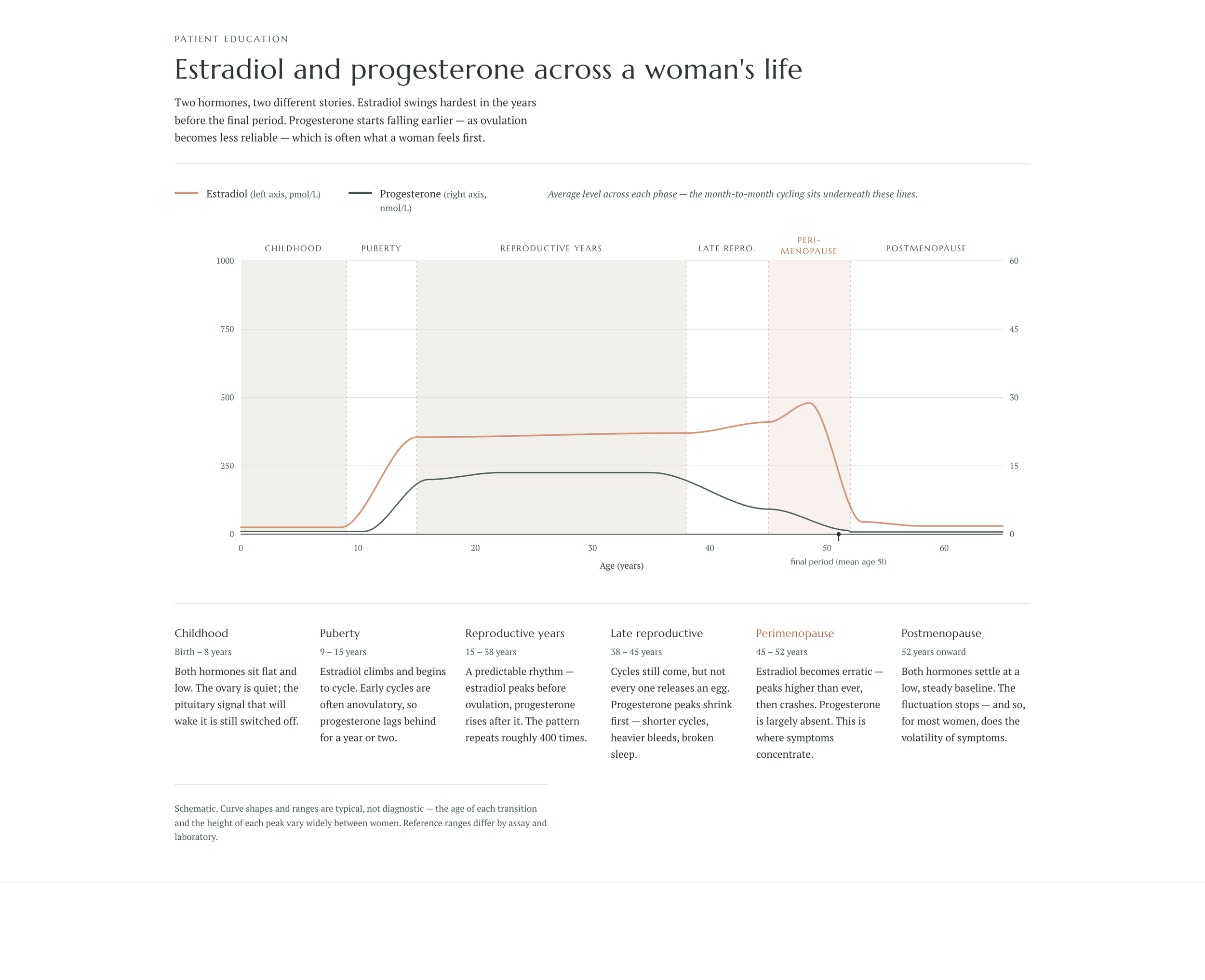
The image below gives you a rough guide at what estradiol and progesterone do across your lifespan. Take a closer look at that estrogen line, and you’ll see it spikes in early peri- yes, that’s right the heavy, short periods, with clotting and crazy level PMS is likely due to a high circulating estrogen.
In worst-case scenarios, if this goes ignored, your iron bottoms out and you end up being recommended a hysterectomy in your 40’s. For most women, they simply feel like they’ve gone back to their teens when they felt completely out of control of their body and emotions- estrogen has significant impacts on your brain!
Please know there is a lot we can do to support your body in this stage! See a Naturopath who is experienced.
Your Family History Is One of Your Most Reliable Clues
Before anything else, have this conversation: talk to your mother.
Research consistently shows that the timing of perimenopause and menopause is significantly heritable. Your mother's experience is your single best predictor of your own. If she entered perimenopause at 42, you may well be approaching it at a similar age. If she experienced early menopause, your risk of an earlier transition is meaningfully elevated.
Ask her:
When did her periods become irregular, heavier, or less predictable?
When did she start experiencing night sweats, sleep changes, or significant mood shifts?
When did she reach menopause, 12 months without a period?
If your mother isn't available, ask your maternal grandmother or a maternal aunt. Write it down. This information is clinically useful, and most women never think to gather it.
The Symptoms That Deserve Proper Investigation
If any of the following sound familiar, and haven't been thoroughly investigated, they warrant a proper assessment.
Sleep changes are often the first signal. Progesterone has a sedative effect; as it declines, sleep quality deteriorates before any other symptom becomes obvious. Difficulty falling asleep, waking between 2 and 4am, or sleeping eight hours and feeling unrested are all characteristic.
Mood changes that feel disproportionate. Increased anxiety, irritability, or emotional reactivity that feels out of character. Progesterone supports GABA, the brain's calming neurotransmitter. When it declines, the nervous system loses a natural buffer. Many women at this stage are offered antidepressants without the hormonal context ever being considered. As a naturopath, I can prescribe GABA as an intervention, and it significantly helps many of my perimenopausal women with the mood shift.
Cycle changes. Shorter cycles (under 25 days), heavier periods, worsened PMS, or occasional skipped periods. These are visible signals, but they often lag the underlying hormonal shift by months.
Fatigue that doesn't respond to rest. Persistent, often worse in the second half of the cycle.
Cognitive changes. Word-finding difficulty, reduced sharpness, difficulty concentrating. Widely reported, rarely attributed to hormones.
Reduced stress resilience. A sense that your capacity to cope has contracted, not because life has gotten harder, but because your buffer has.
What to Test, and Critically, When
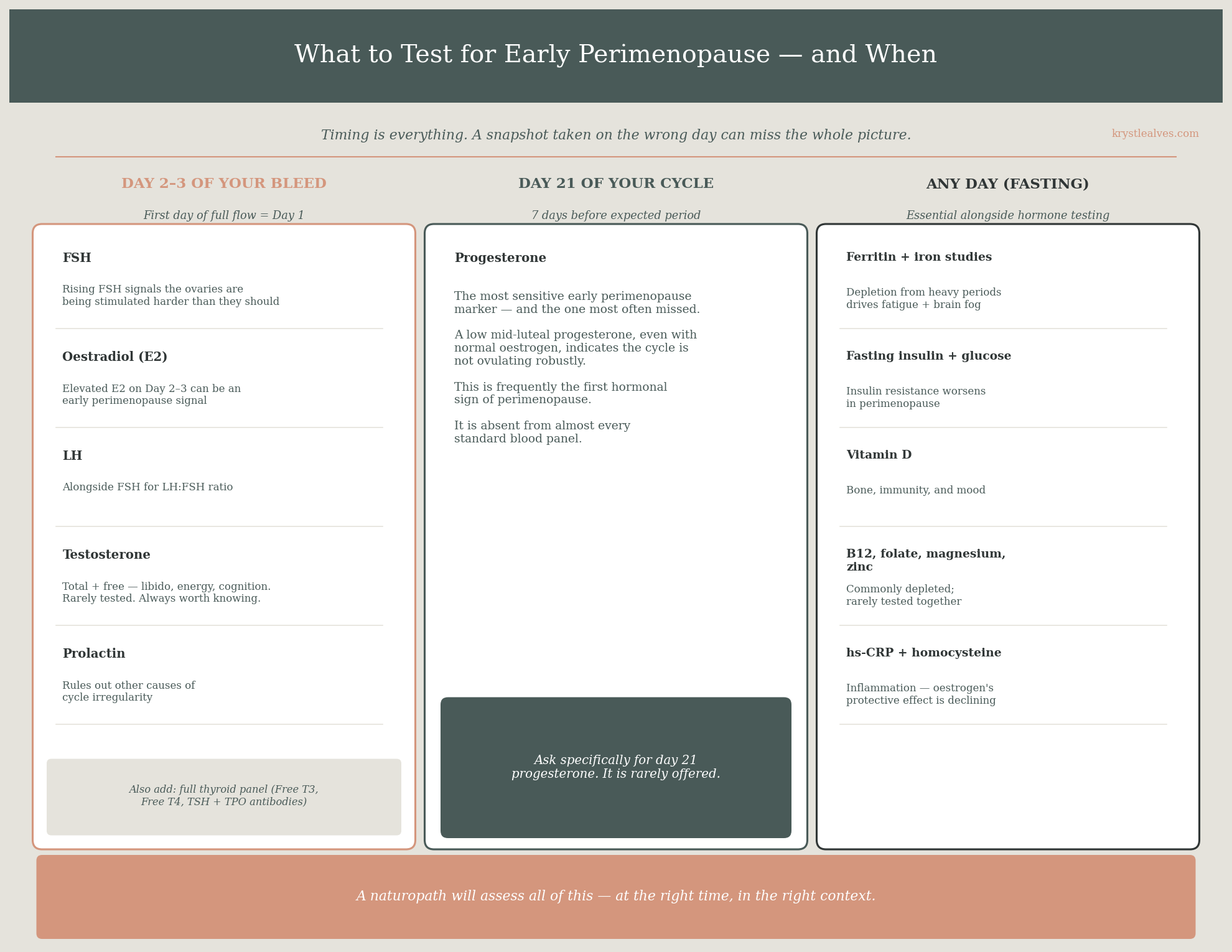
This is where many investigations fall short. Timing is everything.
Day 2–3 of your bleed (first day of full flow = Day 1):
These are your baseline hormones, your "follicular phase" picture.
FSH (Follicle Stimulating Hormone): Rising FSH signals the ovaries are being pushed harder. In early perimenopause it may still be within range, but trending upward over time is meaningful.
Oestradiol (E2): The primary form of oestrogen. On Day 2–3, this should be relatively low. Elevated oestradiol at this point (paradoxically) can be an early perimenopause signal; the FSH is surging to stimulate a follicle harder than it should need to.
LH (Luteinising Hormone): Useful alongside FSH for the FSH:LH ratio.
Total testosterone and free testosterone: Testosterone declines gradually through perimenopause and contributes to libido, energy, mood, and cognitive function. Rarely tested. Worth knowing.
Prolactin: Rules out other causes of cycle irregularity.
Thyroid panel: Free T3, Free T4, TSH, and TPO antibodies. Thyroid dysfunction is significantly more common in this life stage and produces almost identical symptoms. Test every time. In Australia, we have a significant issue with iodine deficiency across the population; without iodine, you can’t make thyroid hormones.
Day 21 (or 7 days before your expected period):
Progesterone: The most sensitive marker for early perimenopause. A low mid-luteal progesterone, even with a normal oestrogen, indicates the cycle is not ovulating robustly. This is often the first hormonal sign of perimenopause and is missed on almost every standard panel.
Any day (fasting preferred):
Full iron studies + ferritin: Iron depletion from years of heavy periods compounds fatigue, mood, and cognition independently of hormones.
Fasting insulin + glucose: Insulin resistance worsens in perimenopause.
25-OH Vitamin D: Relevant to bone, immunity, and mood.
B12, folate, magnesium, zinc
hs-CRP and homocysteine: Inflammation markers; oestrogen's anti-inflammatory protection is declining.
The Gut-Hormone Connection You Probably Haven't Heard About
One factor that rarely comes up in standard perimenopause conversations is the role of the gut microbiome in oestrogen metabolism.
Within the gut lives a collection of bacteria collectively called the estrobolome. These bacteria produce an enzyme, beta-glucuronidase, that reactivates processed oestrogen, allowing it to be recirculated rather than excreted. When the gut microbiome is healthy and balanced, oestrogen metabolism is regulated. When it is disrupted through antibiotic use, a diet low in fibre, chronic stress, or gut inflammation, oestrogen recirculation can increase.
In early perimenopause, when oestrogen is already fluctuating unpredictably, poor oestrogen clearance through the gut compounds the picture. It can contribute to worsened PMS, heavier periods, oestrogen dominance symptoms (breast tenderness, mood instability, bloating), and disrupted hormonal signalling.
Supporting the gut microbiome is not a peripheral consideration in perimenopause. It is directly relevant to hormonal balance. This includes:
Adequate dietary fibre (30g+ daily) to support bacterial diversity
Fermented foods where tolerated (yoghurt, kefir, sauerkraut, kimchi)
Reducing ultra-processed food and alcohol, which actively damage microbial diversity
Addressing any existing gut inflammation or dysbiosis before it compounds the hormonal picture
Where indicated, targeted probiotic support
A naturopath will assess gut health as part of any perimenopause workup, not as a separate concern.
What to Do Right Now
Track your cycle, length, flow, mood across the cycle, sleep, and symptoms. Two to three months of data gives a practitioner something meaningful to work with.
Talk to your mother and maternal relatives about their transition timing. Write it down.
Do not accept "your bloods are normal" without knowing what was tested and when. Ask for a copy of your results. Ask which day of your cycle the blood was drawn. Ask whether progesterone was tested at day 21.
Request the full panel, not just FSH and oestrogen. Thyroid, ferritin, progesterone at the right time, testosterone, and fasting metabolic markers give a real picture.
See a naturopath who specialises in women's hormonal health. A functional assessment will look at what your GP panel is not designed to detect.
How I Work With Women in Early Perimenopause
I see women at exactly this stage every week, many of whom have been dismissed, undertested, or left with more questions than answers.
My approach starts with a full functional assessment: the right hormones at the right time, thyroid, ferritin, metabolic markers, and gut health. I look at your cycle history, your family timeline, and your current symptom pattern across the whole month.
From there, I build a plan specific to your picture: nutritional support to stabilise the hormonal transition, targeted supplementation based on your actual deficiencies, gut health intervention where needed, and nervous system and sleep support.
Early perimenopause is a window. The earlier you understand what's happening, the more effectively you can support the transition.
Should you wish to secure your initial naturopathic health appointment with me, please head acrros to this link to book your session.
This article is for educational purposes. Please discuss any health concerns with your healthcare practitioner.