Why no two women transition the same, and why this stage matters more than most people realise
Perimenopause is one of the most significant physiological transitions a woman will experience, and one of the least understood.
It is not the same as menopause. Menopause is a single point in time: 12 consecutive months without a period. Perimenopause is everything that comes before it, the transition that can last anywhere from 12 months to 12 years, with an average of four to seven years.
In that window, oestrogen and progesterone do not simply decline in a neat, linear fashion. They fluctuate, sometimes dramatically. Oestrogen can spike higher than it ever did during the reproductive years before eventually falling. This erratic hormonal movement is what drives the extraordinary variability in symptoms, timing, and experience that makes perimenopause so difficult to navigate without proper support.
And yet, for many women, this stage passes without adequate investigation, monitoring, or care.
Perimenopause as a Tipping Point in Women's Health
The science is now describing perimenopause as a tipping point in a woman’s life and health, clinically, that is, not metaphorically.
Throughout the reproductive years, the body has significant hormonal resources that buffer the effects of suboptimal sleep, chronic stress, nutrient depletion, and metabolic strain. Oestrogen alone has anti-inflammatory, cardioprotective, and neuroprotective properties. When oestrogen begins to fluctuate and decline, these buffering mechanisms shift.
What this means in practice is that conditions which were previously compensated, borderline thyroid function, low ferritin, blood sugar dysregulation, HPA axis exhaustion, can become clinically apparent for the first time during the perimenopausal transition. The hormonal shift did not cause these issues. But it removed the buffer that was masking them.
This is why a thorough functional assessment during perimenopause so often reveals layers that were not visible before. It is also why addressing what you find can significantly change the trajectory of the transition, and the decade that follows it.
Early Perimenopause: The Subtle Beginning
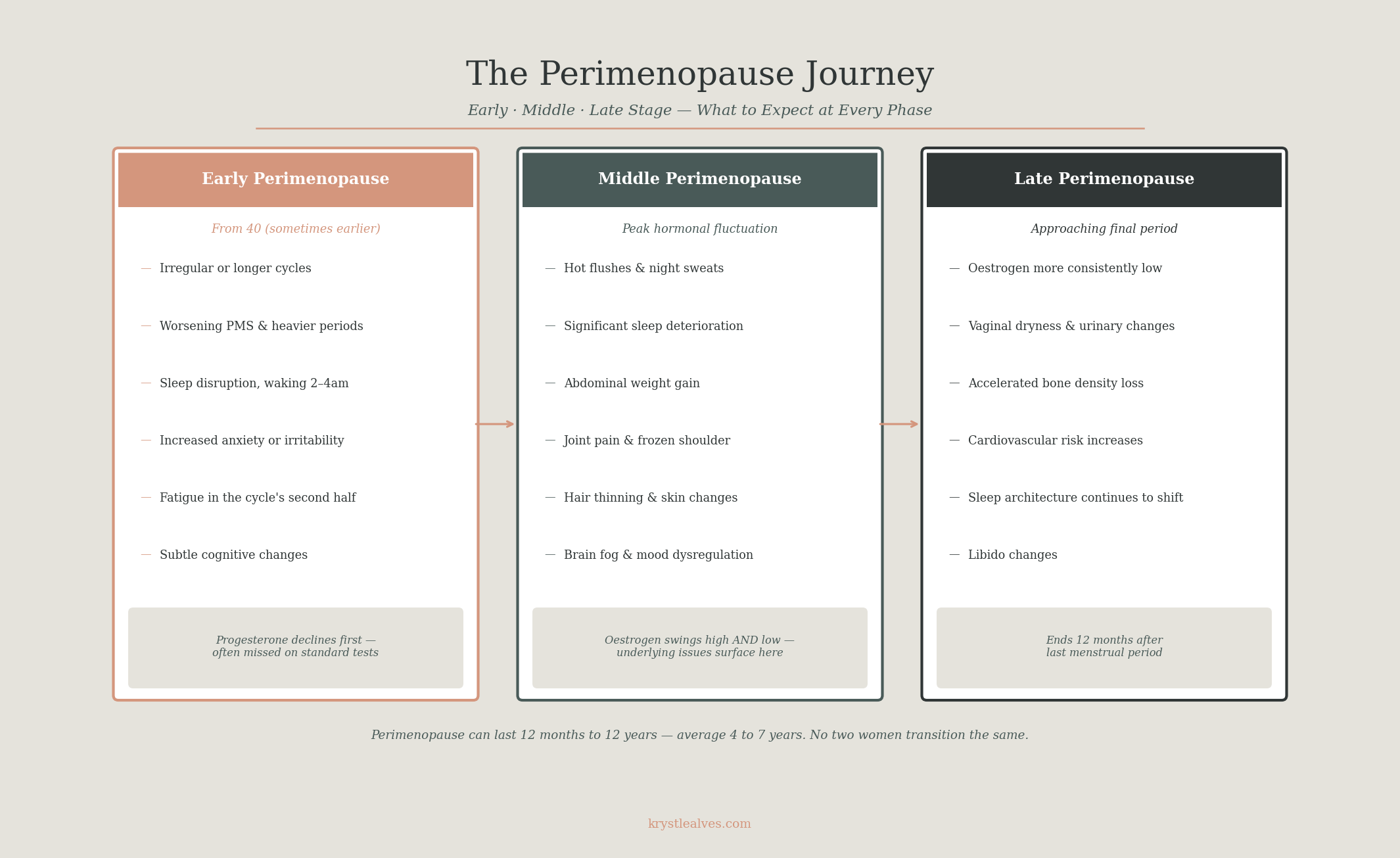
Early perimenopause often begins in the mid to late 40s, though for some women it starts in the early 40s or even late 30s. The most defining feature is menstrual cycle irregularity: periods that arrive earlier than expected, or later, or begin to skip.
But the hormonal shifts are happening before the cycle changes become obvious. Progesterone, which supports sleep, mood stability, and the second half of the cycle, often declines first. This is why early perimenopause frequently presents as:
Sleep disruption: difficulty falling asleep, waking between 2–4am, lighter sleep quality
Mood changes: increased anxiety, irritability, or low mood that feels disproportionate to circumstances
Worsening PMS: heavier periods, increased breast tenderness, more pronounced premenstrual symptoms
Fatigue: particularly in the second half of the menstrual cycle
Subtle cognitive shifts: word-finding difficulty, reduced mental sharpness, increased difficulty concentrating
These symptoms are real, but they are often attributed to stress, lifestyle, or simply "getting older." Many women in early perimenopause are told their hormones are fine because standard testing may show oestrogen within a normal range. Progesterone levels, and particularly how they fluctuate across the cycle, are a more sensitive early marker.
What gets missed: Most standard hormone panels give a single snapshot. Early perimenopause is defined by variability and pattern, not by a single out-of-range result.
Middle Perimenopause: Peak Transition
As perimenopause progresses, hormonal fluctuations become more pronounced and the symptom profile more diverse. This is the stage most associated with perimenopause in popular understanding, and often the point at which women first seek clinical support.
Oestrogen levels swing more dramatically. High enough on some days to drive breast tenderness and fluid retention; low enough on others to trigger hot flushes and vaginal dryness. This variability is characteristic.
Common presentations at this stage include:
Hot flushes and night sweats: ranging from mild and occasional to severely disruptive
Sleep deterioration: now driven by night sweats and altered temperature regulation, compounding the progesterone-related sleep changes of early perimenopause
Weight redistribution: particularly towards the abdomen, even without significant dietary or lifestyle change, driven by shifting oestrogen, rising cortisol, and worsening insulin sensitivity
Joint pain and stiffness: oestrogen has anti-inflammatory properties; as levels fluctuate downward, joint inflammation increases. This is also the stage most associated with frozen shoulder (adhesive capsulitis).
Hair and skin changes: diffuse hair thinning, loss of skin elasticity, dryness, often mistakenly attributed to hormone changes alone when thyroid dysfunction and low ferritin are frequently contributing
Brain fog: reduced concentration, word-finding difficulty, memory gaps, one of the most distressing and least acknowledged symptoms of this stage
Mood dysregulation: oestrogen directly influences serotonin and dopamine pathways; significant hormonal variability can drive pronounced emotional variability
This is also the stage where underlying conditions that were subclinical become apparent. Thyroid function often changes. Blood sugar dysregulation surfaces. Iron deficiency, accumulated from years of heavy periods, compounds the fatigue picture.
What gets missed: Each symptom tends to be assessed in isolation. The pattern, and the drivers beneath it, is rarely looked at as a whole.
Late Perimenopause: Approaching the Transition
In the final stages of perimenopause, oestrogen levels become more consistently low rather than erratically fluctuating. For many women, vasomotor symptoms may actually become more predictable at this stage, though they can also temporarily intensify.
New clinical considerations emerge:
Genitourinary changes: vaginal dryness, urinary urgency, increased susceptibility to urinary tract infections, driven by oestrogen's role in maintaining the health of urogenital tissues
Bone density: the rate of bone loss accelerates in the years surrounding menopause. Late perimenopause is the right time to assess bone density and act proactively.
Cardiovascular health: oestrogen's cardioprotective effects diminish. Lipid profiles, blood pressure, and insulin sensitivity warrant closer monitoring.
Persistent sleep disruption: sleep architecture continues to change; restorative deep sleep becomes harder to access
Libido changes: influenced by declining oestrogen and testosterone (which also declines through perimenopause), and compounded by the cumulative effect of poor sleep, fatigue, and mood changes
The transition is complete when 12 consecutive months have passed without a period; that is the moment of menopause. The physiological effects of lower oestrogen continue into the postmenopausal years, which is why what you do during perimenopause matters beyond the transition itself.
How I Support Women Through Perimenopause as a Naturopath
Perimenopause is not a single symptom to manage. It is a whole-system transition, and it deserves a whole-system response.
As a naturopath with extensive clinical experience in women's health, my approach addresses both the hormonal picture and everything beneath it.
Testing: Seeing the Full Picture
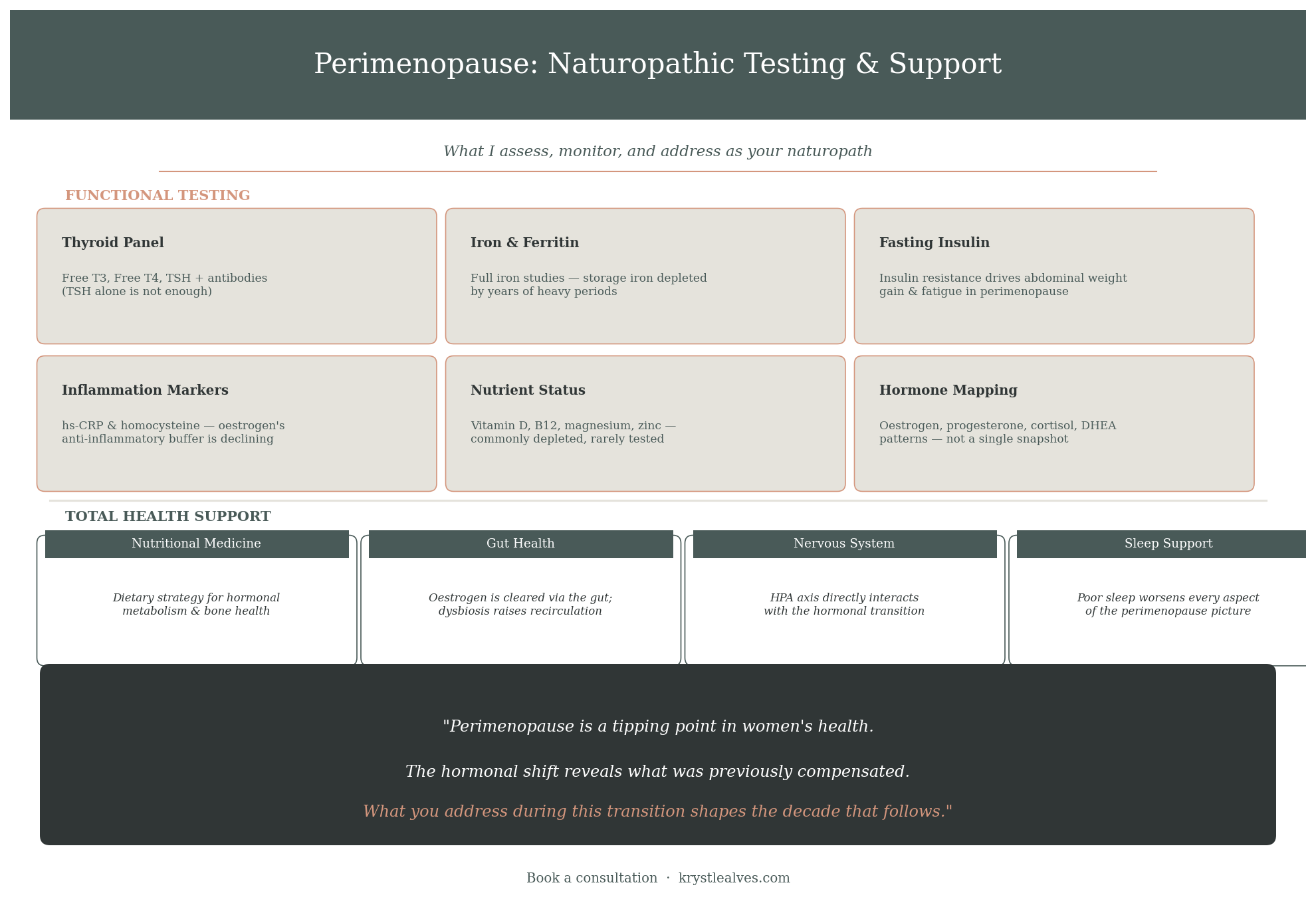
A thorough perimenopause assessment looks well beyond a standard hormone panel. Depending on your stage and presentation, this typically includes:
Full thyroid panel: Free T3, Free T4, TSH, and thyroid antibodies, because thyroid dysfunction is more prevalent in this life stage and produces symptoms that overlap almost entirely with perimenopause
Full iron studies and ferritin: years of heavy menstrual blood loss frequently deplete iron stores, which then drives fatigue, cognitive changes, and hair loss independently of hormones
Fasting insulin and glucose: insulin resistance worsens in perimenopause and drives abdominal weight gain, fatigue, and mood dysregulation
Inflammatory markers: hs-CRP and homocysteine, given the decline in oestrogen's anti-inflammatory protection
Vitamin D, B12, magnesium: commonly depleted, and relevant to mood, sleep, bone health, and nervous system function
Hormone mapping: where indicated, salivary or dried urine hormone testing to assess oestrogen, progesterone, cortisol, and DHEA patterns across the day and cycle — giving far more clinical information than a single serum snapshot
Monitoring: Support That Adapts
Perimenopause is not a one-consultation event. The clinical picture shifts over months and years. Regular review, adjusted as your symptoms evolve, your test results change, and your priorities shift, provides the continuity that most women do not receive from conventional care.
Total Health Support
My naturopathic approach to perimenopause addresses:
Nutritional medicine and dietary strategy to support hormonal metabolism, bone density, and cardiovascular health
Targeted supplementation based on your actual deficiencies and clinical picture, not a generic protocol
Gut health, given its direct role in oestrogen metabolism and systemic inflammation
Nervous system support, because the HPA axis and stress-response system interact directly with the hormonal transition
Sleep, which is both a symptom and a driver; poor sleep worsens every aspect of the perimenopause picture
Evidence-based herbal medicine where appropriate
Perimenopause is a tipping point. What you understand about your body, and what you address during this transition, shapes the decade that follows it.
This article is for educational purposes. Please discuss any health concerns with your healthcare practitioner.