The ApoE Gene, What Your DNA Tells You About Your Brain Health
Why genetic risk is not destiny, and why knowing your ApoE status changes what you do now.
This post is part of a two-part series on brain health in perimenopause and beyond. Read the companion post: [Menopausal Brain Fog, or Something More Serious? →]
Most people think about Alzheimer's disease the way they think about a lightning strike, something that either happens to you or doesn't, determined by forces outside your control.
That framing is just wrong. And it is actively preventing people from taking the most important preventive action of their lives at the time it would make the most difference.
The science of Alzheimer's risk has changed substantially in the last decade. We now understand that the disease process begins fifteen to twenty years before the first symptoms appear, making this disease silent in the most important years when you should be taking action.
We know that lifestyle, metabolic health, and nutrient status are among its most significant modifiable drivers. And we have a genetic test readily available that can tell you whether your risk profile warrants a more aggressive preventive approach.
That test is ApoE genotyping.
As a naturopath who personally carries the genetic mutations leaving me a higher risk and a great-grandmother who died from the disease, what I can say from my own personal experience is that I had a sense of satisfaction at knowing that I had uncovered the genetic link through my own gene testing and that I could now make a real concerted effort to set my life up to facilitate a healthier brain and body and know that I was doing everything I could to reduce my own risk of developing dementia.
What the ApoE Gene Is
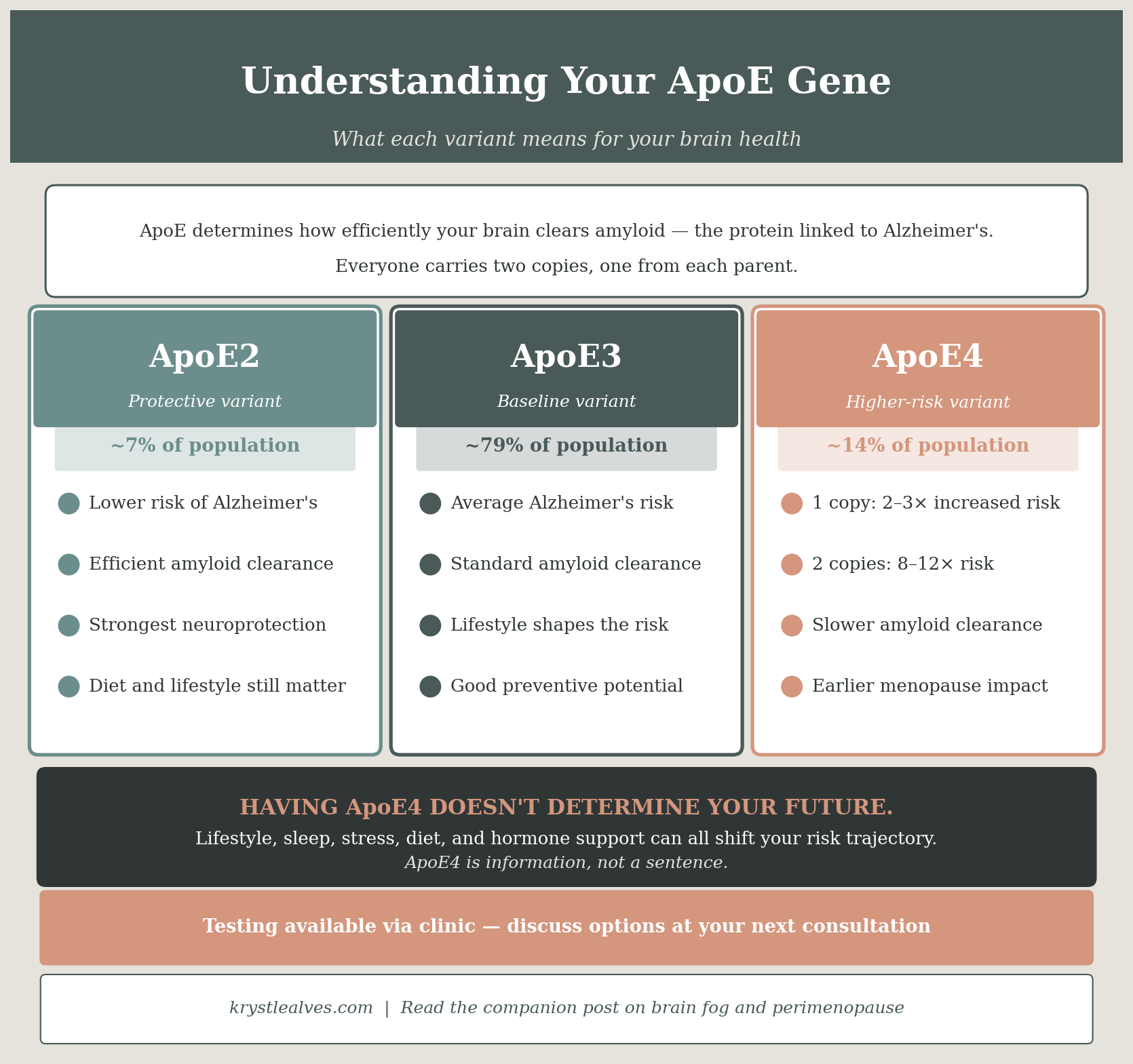
ApoE stands for apolipoprotein E a protein encoded by the APOE gene on chromosome 19. Its primary function is the transport of cholesterol and other lipids through the bloodstream and, critically, within the brain itself. It also plays a central role in neuronal repair, synaptic function, and the clearance of amyloid beta the protein that aggregates into plaques in Alzheimer's disease.
There are three common variants of the APOE gene: ApoE2, ApoE3, and ApoE4.
ApoE2 is the least common variant, carried by approximately 7% of the population. It is associated with reduced Alzheimer's risk and is considered broadly protective.
ApoE3 is the most common variant, present in approximately 79% of people. It confers neither elevated nor reduced risk relative to the general population.
ApoE4 is carried by approximately 14% of the population. It is the most significant known genetic risk factor for late-onset Alzheimer's disease. Carrying one copy of ApoE4 increases lifetime Alzheimer's risk approximately two to three times above baseline. Carrying two copies one from each parent increases risk by eight to twelve times, with an earlier average age of onset.
Everyone inherits two copies of the APOE gene, one from each parent, meaning your genotype is a combination: E2/E3, E3/E3, E3/E4, E4/E4, and so on.
What ApoE4 Actually Does
The elevated risk associated with ApoE4 is not arbitrary. It reflects specific biological differences in how the ApoE4 protein functions compared to the other variants.
ApoE4 is less efficient at clearing amyloid beta from the brain. It is associated with earlier and more significant disruption to the brain's glucose metabolism, the same metabolic vulnerability that Dr Lisa Mosconi's imaging research has documented in perimenopausal women. ApoE4 carriers also show a stronger neurological response to the hormonal changes of perimenopause, with greater metabolic disruption visible on PET imaging compared to non-carriers going through the same hormonal transition.
ApoE4 is also associated with higher cardiovascular risk, elevated LDL cholesterol, greater susceptibility to the effects of saturated fat intake, and less efficient lipid clearance, which matters because cardiovascular and cerebrovascular health are directly relevant to brain health and dementia risk.
Critically: ApoE4 is a risk factor, not a diagnosis. Many ApoE4 carriers never develop Alzheimer's disease. Many non-carriers do. What the genotype tells you is not your fate it tells you the terrain you are working with, so you can match your preventive strategy to your actual risk profile.
Why Knowing Matters
The case for testing is not about fear. It is about precision.
If you do not know your ApoE status, you are managing your brain health based on population-level averages. You may be applying a moderate approach to a situation that warrants a more intensive one or carrying anxiety about risk that isn't warranted by your actual genetic profile.
If you carry ApoE4, there are specific dietary, lifestyle, supplemental, and monitoring strategies that significantly modify risk, and the evidence for their effectiveness is strongest when they are implemented early, before any symptoms emerge. The window of greatest impact is the two decades before cognitive decline would appear, which for most people means their forties and fifties.
This is exactly the window in which most of my patients are sitting. It is also the time when we’re most stressed with career, raising children and caring for parents. So looking after your own health may be at the bottom of the list…. for years.
ApoE Testing Through the Clinic
I offer ApoE genotyping as part of a comprehensive brain health assessment, along with a functional bloodwork panel, dietary review, lifestyle assessment, and cognitive baseline evaluation. Testing is done via a saliva kit, with results typically returned within two to four weeks.
The test is one data point in a broader picture. A positive ApoE4 result without context is anxiety-producing and clinically incomplete. The value of testing through a functional medicine framework is that results are interpreted alongside your metabolic markers, hormonal status, inflammatory load, and lifestyle, giving you a specific, actionable plan rather than a number in isolation.
Remember the term epic-genetics- essentially meaning above the gene- all of the lifestyle factors that impact how genes are expressed and what diseases manifest. You see, you can have the high-risk genes and never develop the disease.
Key Lifestyle Changes That Shift the Trajectory
Whether or not you carry ApoE4, these interventions have the strongest evidence base for long-term brain health. For ApoE4 carriers, they carry additional weight the evidence for risk reduction with lifestyle intervention is substantial and increasingly specific to this genotype.
Diet
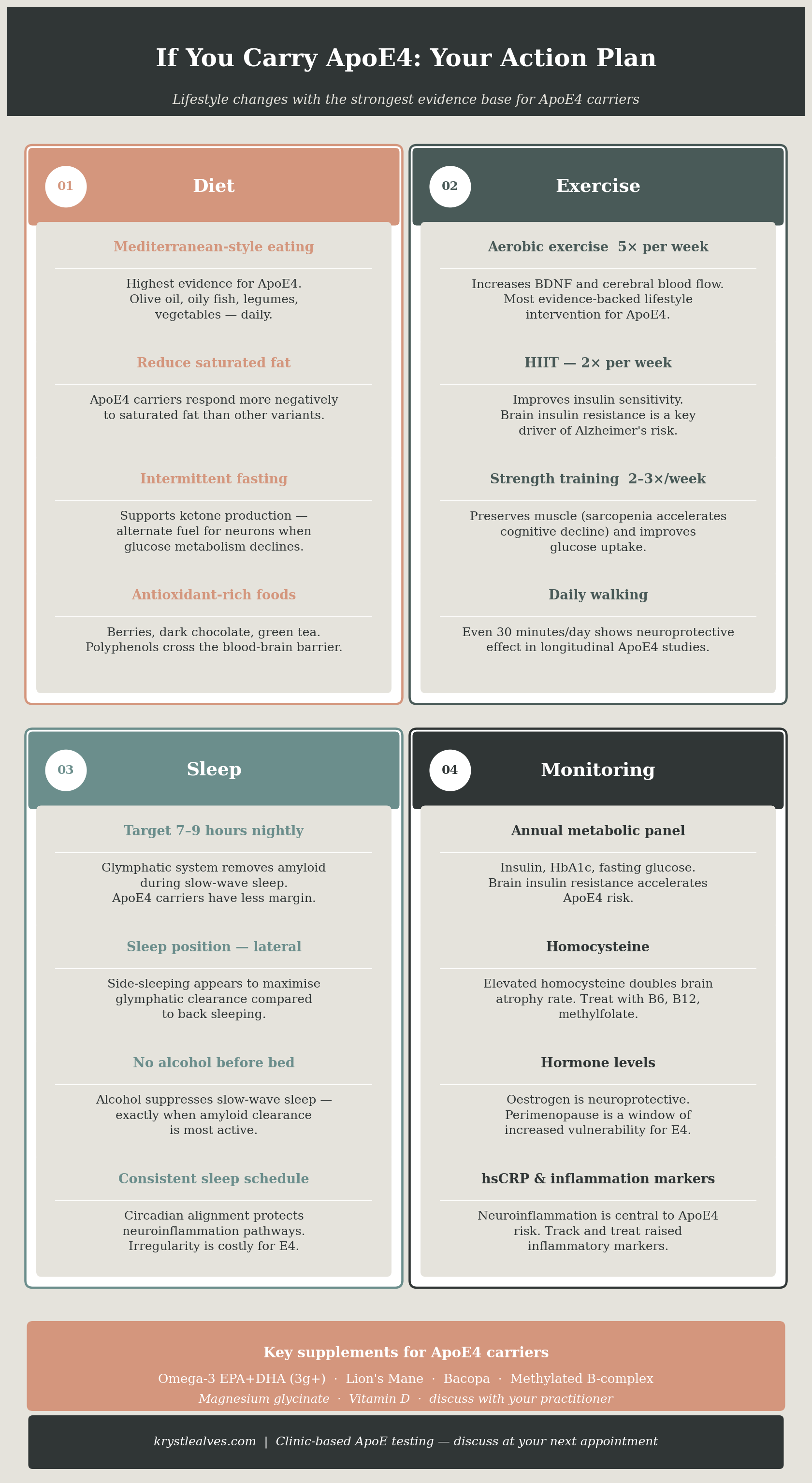
The Mediterranean pattern remains the gold standard. For ApoE4 carriers specifically, the following modifications carry additional evidence:
Reduce saturated fat meaningfully — ApoE4 is associated with less efficient LDL clearance. High saturated fat intake raises cardiovascular risk more significantly in ApoE4 carriers than in those with other genotypes. Prioritise unsaturated fats: olive oil, avocado, nuts, seeds, oily fish.
Increase oily fish to 4–5 times weekly — EPA and DHA omega-3s reduce neuroinflammation, support amyloid clearance, and are among the most robustly evidence-supported interventions for ApoE4 carriers specifically. (Be mindful that salmon and tuna are high in Mercury and other heavy metals; go for sardines and mackerel instead or supplement.)
Prioritise extra virgin olive oil — oleocanthal supports amyloid clearance. Use it liberally as a primary cooking and dressing fat.
Increase polyphenol-rich plant foods — blueberries, leafy greens, cruciferous vegetables, walnuts. Polyphenols reduce oxidative stress in neural tissue.
Minimise ultra-processed food and refined sugar — driving insulin resistance worsens the brain's metabolic vulnerability, particularly relevant for ApoE4 carriers.
Consider reducing alcohol significantly — ApoE4 carriers show a greater neurological response to alcohol's neurotoxic effects. The brain health case for significant reduction is strong.
Exercise, the single most powerful intervention
Aerobic exercise: 150–180 minutes per week at moderate to vigorous intensity. Exercise increases BDNF, reduces amyloid accumulation, improves cerebral blood flow, and critically improves insulin sensitivity and glucose metabolism in the brain. For ApoE4 carriers, this is not optional. It is the most potent single intervention with the most consistent evidence.
Strength training: 2–3 sessions per week — independently associated with reduced dementia risk and improved metabolic health.
Start now, whatever your current fitness level — the neurological benefit is dose-dependent. Any increase is meaningful.
Sleep
The glymphatic system, the brain's waste-clearance mechanism, operates primarily during slow-wave sleep. It is responsible for removing amyloid beta and tau proteins from the brain overnight. Chronically poor sleep accelerates amyloid accumulation.
For ApoE4 carriers, prioritising sleep quality is a direct brain health intervention:
Consistent sleep and wake times — even on weekends. Circadian rhythm disruption impairs glymphatic function.
Aim for 7–9 hours in a cool, dark room.
Address sleep apnoea — a common and underdiagnosed condition with a disproportionate impact on brain health, including amyloid accumulation.
Limit alcohol, which fragments sleep architecture and reduces slow-wave sleep.
Stress management
Chronic cortisol elevation damages the hippocampus, the brain region most involved in memory and worsens insulin resistance. Nervous system regulation is not peripheral to brain health. It is central to it.
Evidence-based strategies include regular mindfulness practice, yoga, breath-work, and any activity that produces genuine recovery from the stress load of daily life. The key metric is not what you do, but whether your nervous system is spending adequate time in recovery.
Metabolic health
Address insulin resistance — fasting insulin alongside fasting glucose gives the early signal. The brain's reliance on glucose as fuel makes insulin sensitivity directly relevant to neurological risk.
Manage blood pressure — hypertension is one of the most significant modifiable risk factors for vascular dementia and Alzheimer's disease.
Know your lipid profile in detail — ApoE4 carriers warrant more careful monitoring of LDL, triglycerides, and the ApoB particle count, given the genotype's effect on lipid metabolism.
Targeted supplementation
For ApoE4 carriers in particular, the following have the most relevant evidence base:
Omega-3 (EPA + DHA): 2–3g daily — the single most evidence-supported supplement for ApoE4-related brain health.
B vitamins (B6, B12, methylfolate) — to reduce homocysteine. Elevated homocysteine accelerates brain atrophy in people with ApoE4 more significantly than in non-carriers.
Vitamin D: to optimal levels (100–150 nmol/L) — correcting deficiency is foundational.
Lion's Mane mushroom — stimulates nerve growth factor, relevant to neuroplasticity and neuronal repair. In clinic, I have seen this significantly improve memory and recall after the onset of symptoms. However, once it’s ceased, brain function returns to it’s baseline within a number of weeks, so continual application is required.
Curcumin (high-bioavailability form) — anti-inflammatory and antioxidant effects within the brain; some evidence for reduced amyloid accumulation.
CoQ10 — mitochondrial support, relevant given ApoE4's effect on mitochondrial function.
What to monitor
A brain health plan for ApoE4 carriers is not set-and-forget. I recommend annual review of:
Fasting insulin, glucose, and HbA1c
Full lipid panel
Homocysteine and hs-CRP
Vitamin D, B12, ferritin
Blood pressure and resting heart rate
Cognitive baseline — using validated assessments to establish a reference point and track any change over time. This is something I routinely run for patients who are concerned in clinic and we run and re-run screening over months/years.
A Word on the Emotional Weight of This Information
Genetic risk information carries weight. Learning that you carry ApoE4 or that you don't can change how you think about your future, your parents, your children.
This is exactly why testing is most useful when done within a clinical relationship where results are explained, contextualised, and followed by a concrete plan. A positive ApoE4 result without support is frightening. A positive ApoE4 result with a clear, evidence-based plan and the understanding that lifestyle intervention meaningfully shifts risk is something different: it is actionable.
The purpose of this testing is not to produce anxiety. It is to enable precision. To do the right things, at the right intensity, in the right window before intervention is no longer possible.
This article is part of a two-part series. Read the companion post: [Menopausal Brain Fog, or Something More Serious? →]
This article is for educational purposes. Genetic testing should be discussed with your healthcare practitioner before proceeding. Please discuss any health concerns with your GP or healthcare practitioner. Krystle is a naturopath and nutritionist who works in Sydney, Australia she has a passion for supporting health improvements for patients who have a complex health history. Deploying advanced testing and screening in order to provide a map forward.