Menopausal Brain Fog or Something More Serious?
What's actually happening in your brain during perimenopause and when it's worth looking deeper
You're mid-sentence and the word is just gone. You walk into a room and have no idea why. You read the same paragraph three times and retain none of it. You used to be sharp. You used to be the person in the room who remembered everything.
And now you're not sure what's happening.
Most women experiencing cognitive changes in perimenopause are told one of two things: it's stress, or it's just part of getting older. Neither answer is satisfying, and neither is complete. The cognitive changes of perimenopause are real; they are measurable, and they have a biological explanation. What matters is understanding what's driving them, how significant they are, and what can be done.
What Is Actually Happening in the Brain
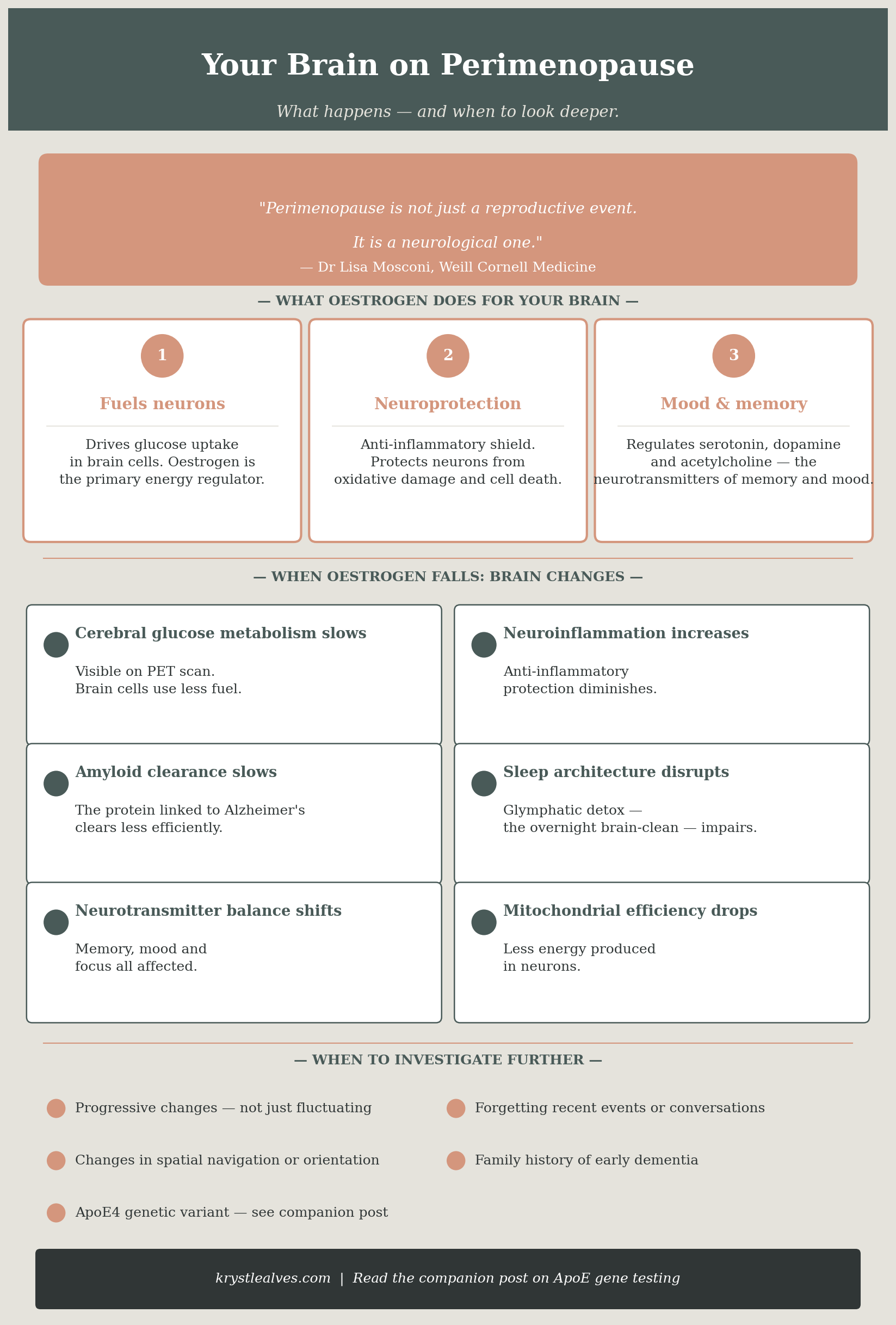
The most important piece of research reframing how we understand the female brain in midlife is the work of Dr Lisa Mosconi, neuroscientist, director of the Alzheimer's Prevention Program at Weill Cornell Medicine, and one of the most compelling voices on this subject.
Mosconi's brain imaging research has produced something extraordinary: PET and MRI scans showing real-time metabolic changes in the brains of women moving through perimenopause. What the scans reveal is that this is not a passive process. The perimenopausal brain is actively remodelling.
The key driver is oestrogen, specifically, its role in brain energy metabolism. Oestrogen is not just a reproductive hormone. It functions as a neuroprotective agent. It fuels the brain's use of glucose, supports mitochondrial function in neurons, regulates cerebral blood flow, and modulates the neurotransmitters, including serotonin, dopamine, and acetylcholine, that underpin mood, motivation, memory, and cognitive speed.
As oestrogen fluctuates and declines in perimenopause, the brain's glucose metabolism shifts. In Mosconi's imaging studies, perimenopausal and menopausal women showed measurably reduced glucose uptake in regions of the brain involved in memory, attention, and executive function, changes that correlate directly with the cognitive symptoms women report. The brain compensates through alternative metabolic pathways, and for most women, cognitive function stabilises post-menopause as the brain adapts to a new hormonal baseline.
But the transition period, which can span years is a window of real neurological vulnerability. And for a subset of women, particularly those carrying specific genetic variants, this window carries implications beyond temporary fogginess.
When to Take It Seriously
There is a meaningful clinical difference between the cognitive changes that are a normal feature of the perimenopausal transition and changes that warrant deeper investigation.
Expect during perimenopause: word-finding difficulty, reduced processing speed, difficulty holding multiple things in working memory simultaneously, and increased distractibility, particularly in the year or two around significant hormonal shift. These tend to be intermittent, worse in the premenstrual window, and to improve with sleep, exercise, and hormonal stabilisation.
Worth investigating further:
Cognitive changes that are progressive rather than fluctuating
Memory gaps that go beyond word-finding: losing track of conversations, forgetting events that happened recently, repeating questions
Changes in spatial navigation or orientation
A sense that the changes are qualitatively different from normal tiredness or distraction
A family history of early dementia or Alzheimer's disease, particularly on the maternal line
Carrying an ApoE4 genetic variant (see our companion post on ApoE gene testing link below)
The perimenopause transition does not cause Alzheimer's disease. But Mosconi's research, and a growing body of evidence, suggests that this is a period when underlying neurological risk factors, particularly those that have been subclinical, can begin to surface. Identifying and addressing them now is the most meaningful thing you can do.
How I Approach Brain Health in the Clinic
My approach to cognitive changes in perimenopause starts with a thorough functional assessment, not reassurance, and not a prescription. The goal is to understand what's driving the changes in your specific case before building a plan.
What I assess first
The cognitive symptoms of perimenopause overlap with a number of treatable conditions that standard testing often misses or addresses incompletely:
Thyroid dysfunction — free T3, free T4, TSH, and thyroid antibodies. Both hypothyroidism and Hashimoto's produce brain fog that is indistinguishable from perimenopausal cognitive change. This is one of the first things I rule out.
Iron and ferritin — iron depletion impairs neurotransmitter synthesis, oxygen delivery to the brain, and mitochondrial function. Low ferritin is one of the most consistently underestimated drivers of cognitive fatigue.
B12 and folate — B vitamins are required for methylation, the process by which homocysteine is cleared. Elevated homocysteine is an independent risk factor for cognitive decline and is correctable.
Vitamin D — receptors for vitamin D are present throughout the brain, and deficiency is associated with impaired cognition and elevated Alzheimer's risk.
Fasting insulin and glucose — insulin resistance impairs the brain's ability to utilise glucose as fuel, a process directly relevant to the neurological changes Mosconi describes. The brain, like the body, can become insulin resistant.
Inflammatory markers — hs-CRP and homocysteine. Neuroinflammation is a significant driver of cognitive decline, and oestrogen's anti-inflammatory role means its decline can unmask or accelerate inflammatory processes.
Hormone mapping — oestrogen, progesterone, testosterone, cortisol, and DHEA. The hormonal picture informs the severity of the transition and the degree of neuroprotective support that's been lost.
For women where the picture warrants it, I offer ApoE gene testing as part of a broader functional genetics panel, because knowing your genetic risk profile changes how aggressively and specifically we intervene. [Read more about ApoE testing and what it means for your brain health →]
The Support Plan
No two treatment plans are ever the same within my clinical practice; priority is first given to uncovering the key drivers that are contributing to the cognitive decline. This generally involves in-depth pathology or functional screening done through private labs.
You can spend years taking some magnesium and ginkgo and hoping for the best- the technology in health has moved to such a degree that we now have access to an array of screening tools that give us insights to your own unique health picture and requirements.
So the first steps we’ll take together are often testing and discovery. However, some of the interventions generally available for your consideration are outlined below.
Nutrition for the brain
The Mediterranean dietary pattern has the strongest evidence base for brain health and Alzheimer's risk reduction. Practically, this means:
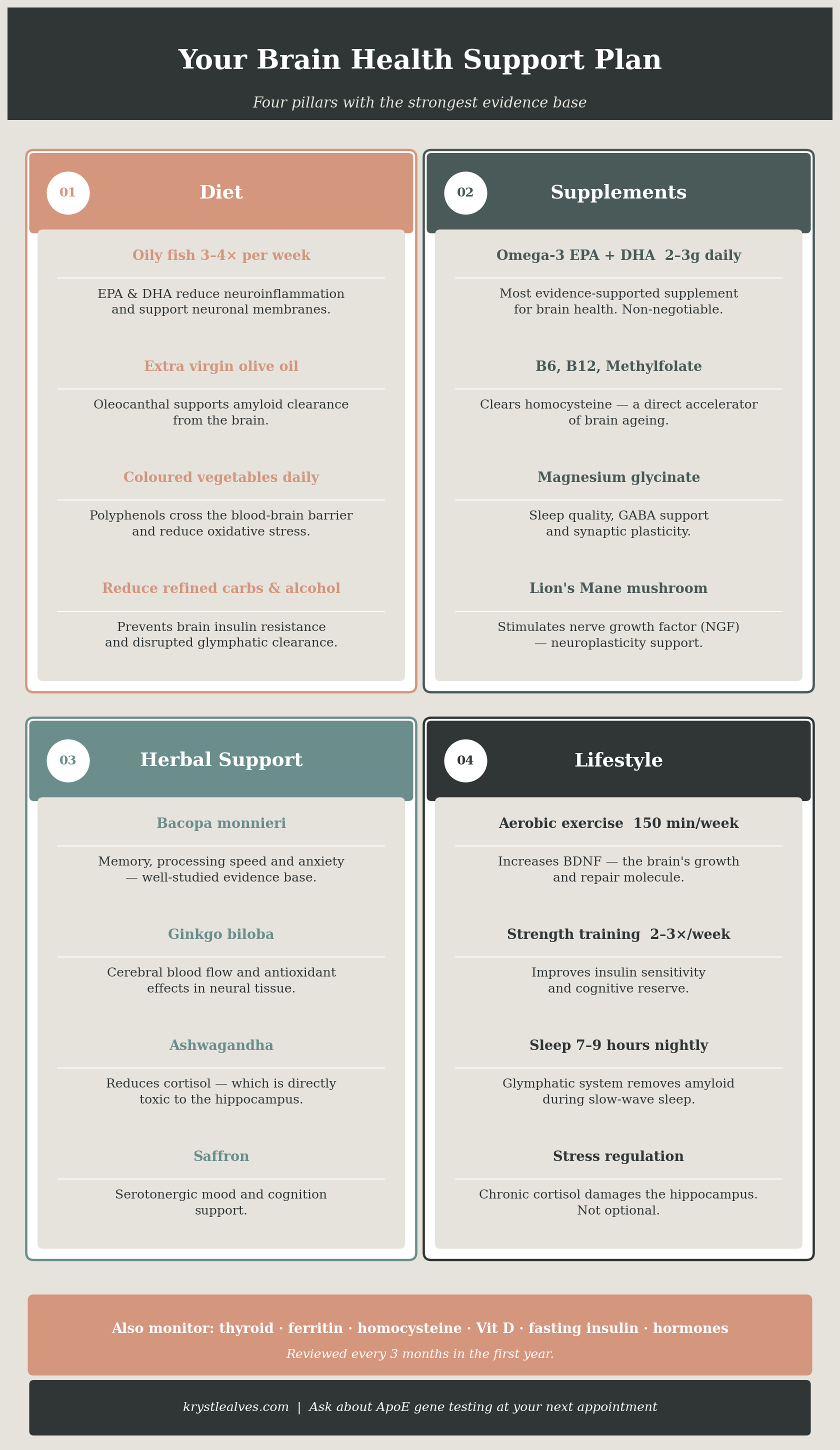
Oily fish 3–4 times weekly — salmon, sardines, mackerel, anchovies. The omega-3 fatty acids EPA and DHA are structural components of neuronal membranes and have direct anti-inflammatory and neuroprotective effects.
A diversity of coloured vegetables — polyphenols (found in deeply coloured plant foods) cross the blood-brain barrier and exert antioxidant and anti-inflammatory effects within neural tissue.
Extra virgin olive oil daily — oleocanthal, a compound in high-quality EVOO, has been shown to support the clearance of amyloid proteins from the brain, the same proteins that accumulate in Alzheimer's pathology.
Walnuts and seeds — omega-3s, vitamin E, and zinc, all relevant to neuronal membrane integrity and neurotransmitter function.
Eggs — choline is essential for acetylcholine synthesis, the neurotransmitter most directly involved in memory. It is also required for methylation.
Minimising ultra-processed food and refined carbohydrate — these drive the insulin resistance that impairs cerebral glucose metabolism.
Alcohol reduction — alcohol is directly neurotoxic and disrupts sleep architecture, both of which worsen cognitive function in perimenopause.
Key supplements
Supplementation is targeted to your individual deficiencies and clinical picture, not a generic stack. The following have the strongest evidence base for brain health support in the perimenopausal context:
Omega-3 (EPA and DHA) — 2–3g daily of a high-quality marine source. Central to neuronal membrane health and the reduction of neuroinflammation.
B vitamins (B6, B12, folate/methylfolate) — essential for homocysteine clearance. Elevated homocysteine is modifiable and directly associated with accelerated brain ageing.
Magnesium glycinate or threonate — supports GABA function (reducing anxiety and improving sleep quality) and has emerging evidence for supporting synaptic plasticity.
Vitamin D — correcting deficiency is foundational. Optimal levels are 100–150 nmol/L, not merely above 50.
CoQ10 — mitochondrial support. As oestrogen declines, mitochondrial efficiency in neurons decreases; CoQ10 supports ATP production at the cellular level.
Lion's Mane mushroom — contains hericenones and erinacines, compounds shown to stimulate nerve growth factor (NGF) synthesis, relevant to neuroplasticity and neuronal repair.
Herbal support
Bacopa monnieri — one of the most studied herbs for cognitive function. Clinical trials demonstrate improvements in memory, processing speed, and reduction in anxiety with sustained use.
Ginkgo biloba — supports cerebral blood flow and has antioxidant effects within neural tissue. Most effective as a standardised extract at therapeutic doses.
Saffron — emerging evidence for its role in mood and cognition via serotonergic pathways, with a safety profile that makes it a useful adjunct in perimenopausal women.
Ashwagandha — adaptogenic support for the HPA axis. Chronic stress elevates cortisol, which is directly neurotoxic in the hippocampus, the brain region most involved in memory formation.
Lifestyle inputs that matter most
Sleep — the glymphatic system, which clears metabolic waste from the brain (including amyloid proteins), operates primarily during slow-wave sleep. Disrupted sleep during perimenopause is not just a quality-of-life issue, it is a brain health issue.
Aerobic exercise — the most robust lifestyle intervention for brain health. Exercise increases BDNF (brain-derived neurotrophic factor), the molecule responsible for neuroplasticity and the formation of new neural connections. Aim for 150 minutes of moderate-intensity aerobic activity weekly.
Strength training — independently associated with reduced cognitive decline and improved insulin sensitivity, both relevant here.
Stress reduction — chronic cortisol elevation damages the hippocampus and impairs memory consolidation. Nervous system regulation is not optional in this picture.
Monitoring
Cognitive health in perimenopause is not a one-appointment event. I review progress at regular intervals, typically every three months in the first year, adjusting the plan as the hormonal picture shifts, test results change, and symptoms evolve.
A Note on What This Is Not
This is not a suggestion that perimenopause causes dementia. For the vast majority of women, cognitive changes in this transition are temporary, explainable, and manageable.
What the evidence does suggest is that this is a window, a period in which the foundations of long-term brain health are being laid. What you eat, how you move, how you sleep, how your thyroid and metabolic markers sit, whether your nutrient status is adequate- all of these things are more consequential in this period than they will be at any other point in your adult life.
For those with a family history of early cognitive decline, or who want to understand their genetic risk profile more precisely, ApoE gene testing is available through the clinic as part of a comprehensive brain health assessment.
[Read the companion post: The ApoE Gene, What Your DNA Tells You About Your Brain Health →]
This article is for educational purposes. Please discuss any health concerns with your GP or healthcare practitioner.